Deep-rooted in Nature,
Ciel d'Azur, for Sure, it's Pure!


Clay forms as a result of the hydration of feldspar* produced by granitic rock.
It is a sedimentary rock notably made up of hydrated aluminium silicate.
* Feldspars are the largest group of minerals in the Earth’s crust.
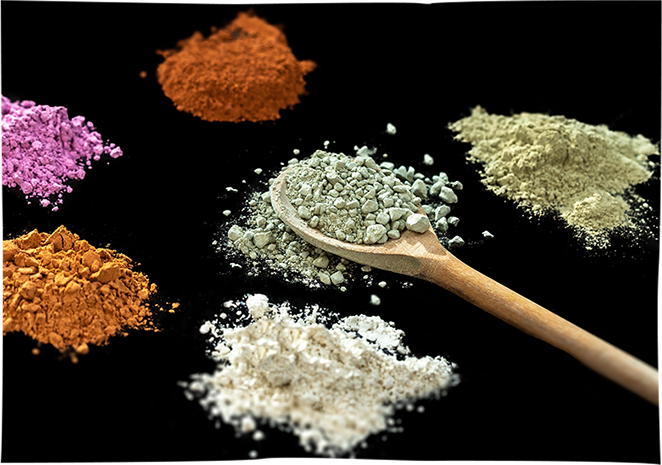
Chlorite can colour the clay green. All metals, notably including iron but also manganese, magnesium and copper, among others, can colour clay:
Fe+ = yellow clay
Fe++ = red clay
Fe – = green clay
Yellow and red clays respectively are the result of increasingly active exposure to the air (Fe+ and Fe++), whilst green-coloured clay owes its colouring to the fact that it is sheltered from the air as it forms (Fe -).
Colour is also not synonymous with efficiency. Montmorillonite, which is a very active clay, for example, can be yellow, pink, green, etc.
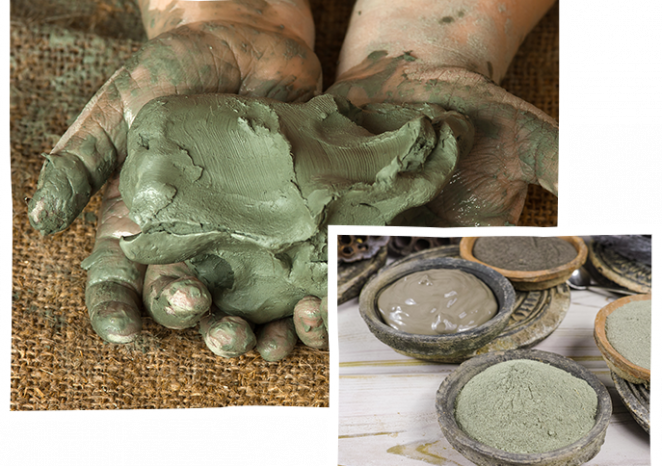
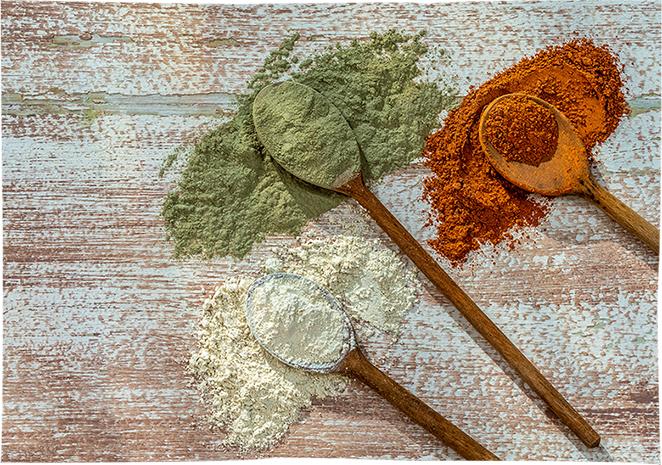
There are several types of clay:
o Smectits
o Bentonites
o Montmorillonite
o Halloysitis
These clays have ADsorbent or ABsorbent properties (depending on the type).
Clay is a material endowed with nature’s intelligence and one that is therefore conducive to life, binding anything that is contrary to life by means of ADsorption and providing elements that are conducive to it by means of an ion exchange phenomenon (Smectites and Bentonites) or by ABsorption, whereby it acts like a sponge (Illites).
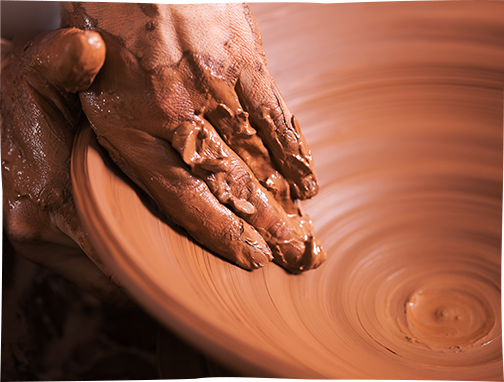
o Kaolin: white clay from Kao Ling in China
o Illite: the most common clay, also known as ‘pottery clay’.